Open source vs closed source
Anuma offers both. The difference is who runs the model and what happens to what you send.
Available on: web, iOS, Android.
Open-source models (the Private section)
Kimi, Qwen, MiniMax, GLM and Ling are open-weight models run under zero-data-retention terms: the provider does not keep your prompts. They carry the Private badge in the picker. That badge is about retention at the provider; it does not control Nearby sharing (the eye icon does), and your memories work the same with every model.
Closed-source models
GPT, Claude, Gemini and Grok run on their providers’ servers. Your prompt and the context Anuma adds go to the provider so it can answer, under that provider’s own retention and training terms.
Model privacy
Settings → Models has one control, Model privacy:
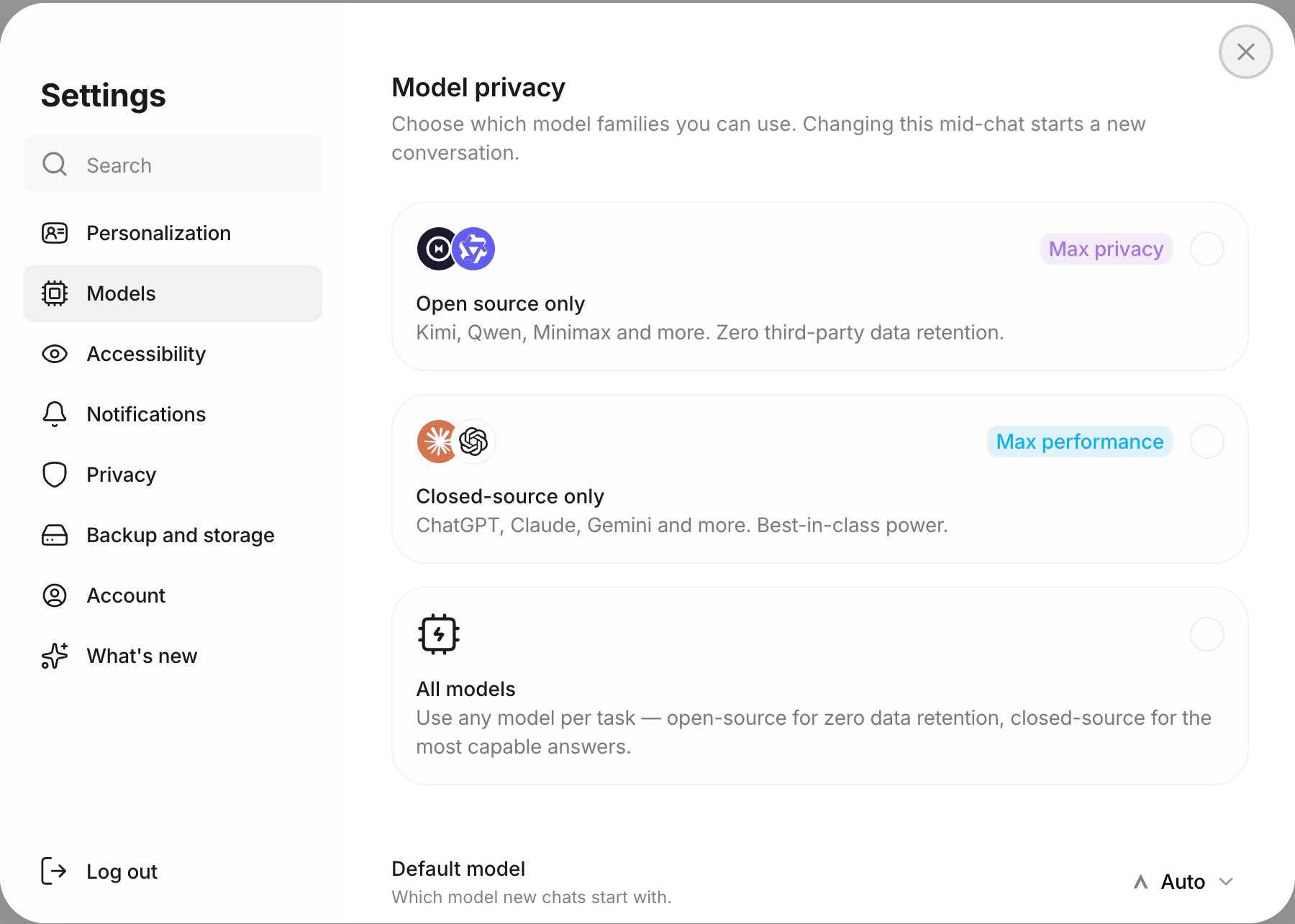
- Open source only. Maximum privacy. Only Private models appear, and Auto routes only to them.
- Closed-source only. Maximum capability.
- All models. Pick per task.
Changing it starts a new conversation.
New web accounts start on Closed-source only. Pick Open source only or All models at the model step during sign-up, or here at any time; a choice you already saved is never changed for you.
Which to use
Use a Private model when the topic is sensitive and when you want zero retention. Use a closed-source model when you want the strongest reasoning or a specific flagship. Auto blends them within your Model privacy setting, and Council Mode can mix both in one session.
Related articles